What Should You Do Immediately After a House Fire?
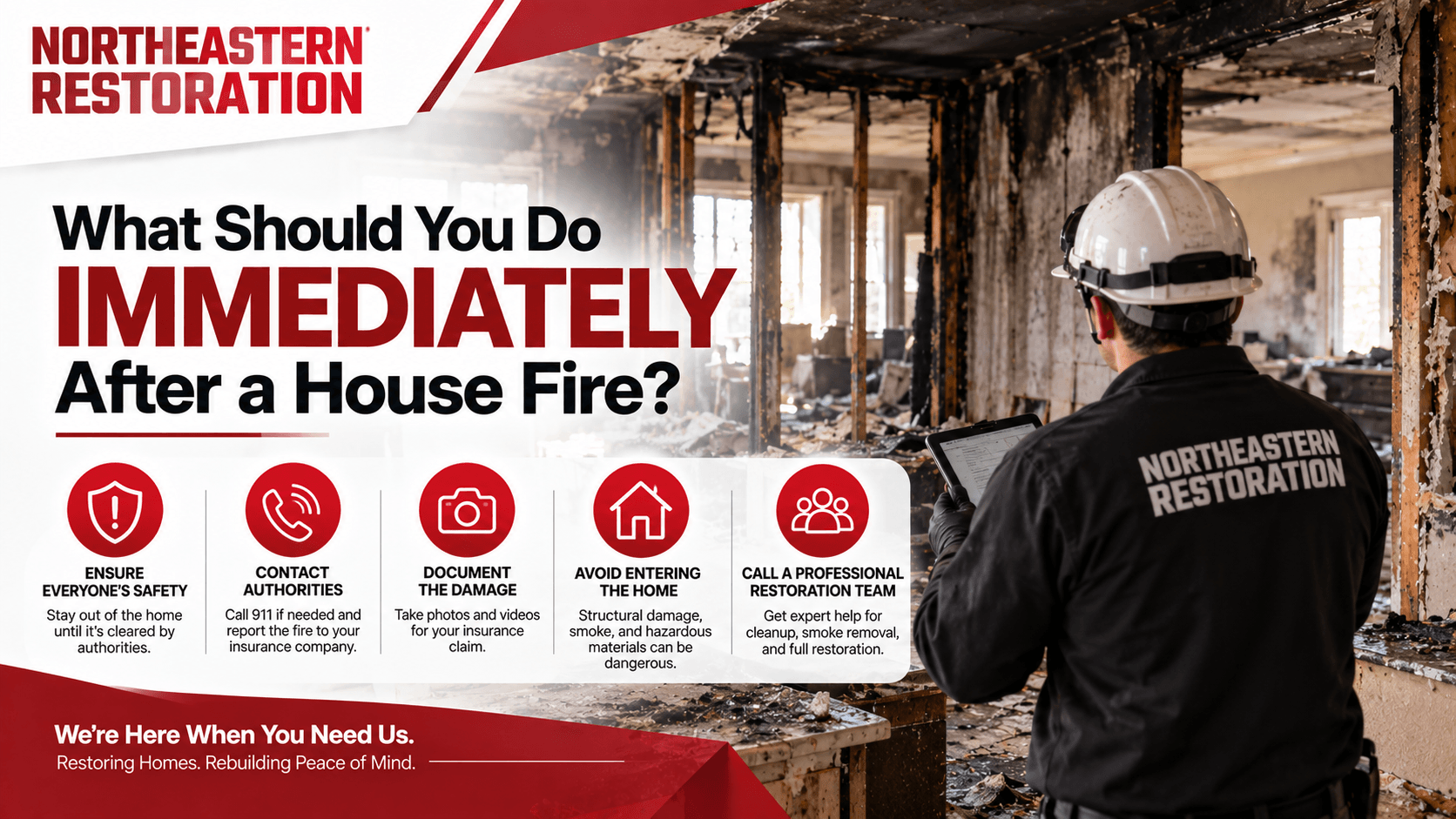
The First Five Steps to Take Immediately After a House Fire
Immediately after a house fire, do the following in order: (1) Stay out until the fire marshal clears the structure. (2) Do not use any utilities until each has been inspected. (3) Avoid disturbing soot. (4) Document all damage with photos and video before anything is touched. (5) Contact your insurance company and a licensed fire damage restoration company. The decisions made in these first 24 to 48 hours have a direct and lasting impact on your insurance claim, the scope of restoration work, and how quickly recovery can begin.
Immediate Safety Steps That Must Come Before Anything Else
Before making calls, before photographing damage, before assessing what was lost — these safety steps are non-negotiable. A fire-damaged structure is not the same building it was before the event.
- Stay out until cleared by the fire department. Do not re-enter the structure until the fire marshal or incident commander declares it safe. Even a contained fire can leave unstable structures, compromised electrical systems, and toxic air quality that is not visible from the outside.
- Do not use utilities until inspected. Gas, electricity, and water lines may have been damaged by heat, flame, or firefighting efforts. Do not use any utility until each system has been inspected and cleared by a qualified professional.
- Avoid disturbing soot. Soot is acidic and spreads on contact. Walking through soot-covered areas before restoration professionals arrive compounds the damage. Chemical staining can become permanent within 48 to 72 hours.
- Document everything before any cleanup begins. Once safely cleared to enter, photograph and video every affected area, surface, and belonging before anything is moved or removed. This documentation is the foundation of your insurance claim.
- Secure the structure. Contact a fire damage restoration company immediately to arrange emergency board-up and tarping. Open damage exposes the structure to weather, animals, and further loss that compounds quickly.
The Four Calls to Make Within the First 24 Hours
After immediate safety is addressed, four critical calls need to happen quickly. Making them out of sequence can create insurance claim complications or delay structural protection.
1. Your Homeowners Insurance Company
Notify your insurer as soon as possible — ideally within the first few hours. Most policies require prompt notification as a condition of coverage. Ask explicitly whether you are approved to authorize emergency protective work before an adjuster visits. Nearly all policies require policyholders to take steps to prevent further damage, and emergency board-up qualifies.
2. A Licensed Fire Damage Restoration Contractor
Call a fire damage restoration contractor immediately after notifying your insurer. A company with 24/7 emergency response can have a team on-site within hours to handle board-up, water extraction from firefighting efforts, soot assessment, and the scope of loss documentation your adjuster needs. Starting this process early limits secondary damage and builds the evidence base for your claim.
3. Your Mortgage Lender
If you have a mortgage, your lender typically needs to be notified of significant fire damage. Insurance claim payments above a certain threshold are often issued jointly to you and your lender — knowing this early prevents surprises when settlement funds arrive.
4. Local Building Authorities If Required
In some jurisdictions, significant structural fire damage must be reported to the local building department. Confirm with your contractor or insurer whether any local notification is required in Athens, Georgia, beyond what the fire department's incident report addresses.
Critical Mistakes to Avoid After a House Fire
Actions taken in the first hours with good intentions often complicate both the restoration process and the insurance claim. These are the most consequential mistakes to avoid:
- Do not attempt to clean soot yourself. Soot requires specialized dry sponges and chemical cleaners applied with specific technique. Standard household cleaners react with soot chemistry and drive staining deeper into surfaces, converting a cleanable problem into a replacement.
- Do not run the HVAC system. If the heating or cooling system ran during or after the fire, soot is already in the ductwork. Running it again distributes contamination to every room, dramatically expanding the smoke remediation scope.
- Do not discard any damaged items. Your adjuster needs to assess all damaged belongings before disposal. Discarding items — even those that appear unsalvageable — before documentation can reduce your contents payout.
- Do not move back in without professional clearance. Fire-damaged homes may contain elevated carbon monoxide, compromised structural members, active electrical hazards, and harmful soot particulate in the air. Air quality and structural assessments should precede any re-occupancy.
- Do not accept a settlement before restoration is fully scoped. Initial settlement offers sometimes underestimate the complete restoration cost. Your contractor's scope of loss documentation is the basis for a complete and accurate settlement — do not waive that process.
Navigating Your Fire Damage Insurance Claim in Athens, GA
Fire damage insurance claims involve multiple coverage components — dwelling coverage for structural damage, contents coverage for personal property, and additional living expense coverage for temporary housing — each with its own limits, deductibles, and documentation requirements.
Your restoration contractor plays a direct role in the claims process. A qualified fire damage company documents all affected areas, provides itemized scopes of loss organized by coverage category, and communicates directly with your adjuster throughout the job. This documentation is what allows your insurer to process a complete and accurate claim rather than a preliminary estimate that may miss significant damage discovered after the initial visit.
In Athens, Georgia, you have the right to review and question your adjuster's estimate before accepting any settlement. If the initial offer does not reflect the true restoration scope, your contractor can provide supporting documentation. In disputed cases, a public adjuster — who represents your interests rather than the insurer's — can review your policy and negotiate on your behalf.
Frequently Asked Questions About What to Do After a House Fire
Where should I stay if my home is uninhabitable after a fire?
Your policy's additional living expense coverage typically pays for temporary housing, meals, and displacement costs while restoration is underway. Contact your insurer immediately to understand the limits and process, and keep all receipts for displacement-related expenses.
Can fire-damaged belongings be cleaned and restored, or do they need to be replaced?
Many items can be professionally cleaned — clothing, upholstered furniture, electronics, documents, and photographs. Specialized content restoration companies offer cleaning services separate from structural work. Your insurer should cover cleaning costs for salvageable items before concluding they need replacement.
How long does a fire damage insurance claim typically take to resolve?
Simple claims can resolve in a few weeks. Complex claims involving extensive structural damage, disputed coverage, or large content losses can take several months. Thorough documentation and a contractor who communicates directly with your adjuster are the most effective ways to accelerate the process.
What if the fire was caused by a neighbor or third party?
File your own claim first to ensure immediate coverage. Your insurance company may pursue subrogation — recovering their payout from the responsible party's liability insurance. Document the cause of the fire as thoroughly as possible to support that process.
Is smoke damage covered under the same policy as fire damage?
Yes. Standard homeowners policies cover fire and resulting smoke damage under the same dwelling and contents coverage. Smoke remediation — including cleaning, deodorization, and HVAC treatment — is part of the covered restoration scope when fire is the originating event.
Taking the Right Steps After a House Fire Changes the Outcome
The hours immediately following a house fire are critical — not because the situation can be reversed, but because the decisions made during that window determine how effectively and completely recovery unfolds. Prioritizing safety, documenting thoroughly, and making the right calls in the right order puts you in the strongest possible position.
Northeastern Restoration provides 24/7 emergency fire damage response throughout Athens, GA and surrounding counties. Our team handles emergency board-up, water extraction, soot assessment, and full insurance documentation from the first call through final restoration. Call us at
(678) 235-9436 any time.