How Do Restoration Companies Work With Your Insurance?
The Short Answer: They Document, Scope, and Communicate on Your Behalf
Restoration companies work with your insurance by producing the damage documentation, scope of loss, and cost substantiation your insurer needs to process your claim accurately. They communicate directly with your adjuster, submit supplemental claims when hidden damage is discovered, and provide the final closeout documentation that completes the claim file. A restoration contractor who does this well is one of the most valuable participants in your claims process — and one who doesn't can cost you thousands in an incomplete settlement. This guide explains exactly how the relationship works, what to look for in a contractor, and what contractors are not allowed to do.
The Restoration Company's Role in Your Insurance Claim
When a covered loss occurs, your insurer sends an adjuster to assess the damage and develop a repair estimate. That estimate is based on a single visit — typically one to two hours. A thorough restoration contractor does something the adjuster cannot: they are present throughout the entire job, documenting conditions as they evolve and identifying damage that only becomes apparent after drying, demolition, or cleaning begins.
This ongoing documentation role matters substantially. Hidden damage — mold behind walls, compromised framing visible only after drywall removal, secondary water migration not apparent during the initial inspection — is regularly discovered during restoration. A contractor who documents these findings and communicates them to your adjuster in real time ensures the final settlement reflects the full cost of complete restoration, not just what was visible on day one.
In Athens, Georgia, where water events frequently reveal hidden moisture problems that have been developing longer than the acute incident, this continuous documentation role is especially valuable. Homeowners working with contractors who produce detailed documentation consistently receive more complete settlements than those whose contractors simply send a final invoice.
How the Restoration and Insurance Claim Process Works Step by Step
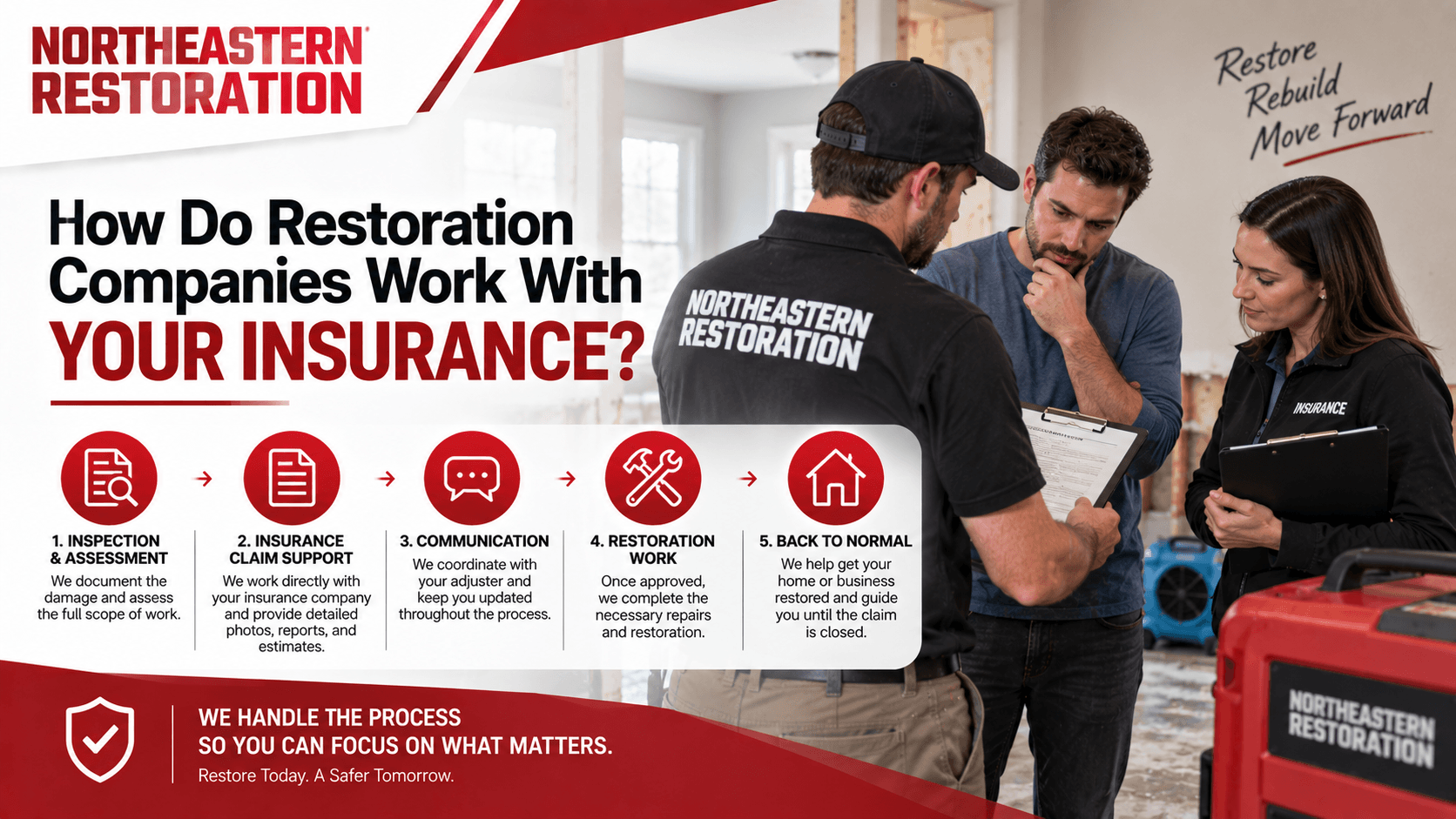
The interaction between a restoration contractor and an insurance company follows a predictable sequence on most claims. Understanding this sequence helps you know what to expect at each stage:
- Initial loss report and emergency response. You report the claim to your insurer and notify your restoration company simultaneously. A qualified contractor in Athens, GA can begin emergency mitigation immediately — water extraction, board-up, tarping — without waiting for adjuster approval. Most policies require you to take reasonable steps to prevent further damage, and emergency mitigation meets that standard.
- Joint inspection and documentation. Your restoration contractor and the insurance adjuster ideally inspect the property together — or the contractor provides a detailed damage report to inform the adjuster's visit. This ensures the adjuster's assessment is based on the contractor's full moisture mapping, photo documentation, and initial scope rather than a surface-level walkthrough.
- Scope of loss preparation. The contractor prepares a detailed, line-item scope of loss document describing every area of damage, every service to be performed, every material to be removed and replaced, and the associated cost. This document is the primary basis for the insurance settlement.
- Adjuster review. The adjuster reviews the scope and either approves it, requests modifications, or issues a preliminary settlement. When the adjuster's estimate differs from the contractor's scope, the contractor provides supporting documentation — moisture logs, photographs, industry cost references — to substantiate the full scope.
- Supplemental claims. As restoration progresses and additional damage is discovered, the contractor documents each finding and submits supplemental claims to the insurer. This is a normal, expected part of the process on most significant restoration jobs — not a dispute.
- Final documentation and claim close. Upon completion, the contractor provides final documentation confirming all work performed. Combined with before-and-after photographs and moisture logs, this closeout package completes the claim file.
What to Look for in an Insurance-Experienced Restoration Contractor in Athens, GA
Not all restoration companies have the same depth of experience working within the insurance claims process. These four qualities distinguish contractors with genuine insurance experience:
Detailed, Line-Item Scoping
A strong contractor produces scopes of loss that are specific and itemized — not general summaries. Adjusters process itemized documentation more efficiently, and detailed scopes reduce the likelihood of disputes about what the restoration actually required.
Direct Adjuster Communication
The best contractors communicate directly with your adjuster rather than routing all technical questions through you. This keeps scope and methodology conversations with the people best equipped to have them, reduces back-and-forth delays, and keeps the claim moving.
Experience With Supplemental Claims
Supplemental claims for additional damage discovered during restoration are normal on complex jobs. A contractor with established supplement procedures and carrier relationships processes them faster than one who submits them without context or supporting documentation.
Pricing Aligned With Xactimate
Most insurance adjusters use Xactimate — the industry-standard estimating platform — to develop their repair cost estimates. Contractors familiar with Xactimate and who price consistently with its methodology create less friction in the claims process than those who submit pricing outside the established framework.
What a Restoration Contractor Is Not Permitted to Do in the Insurance Process
There are clear boundaries to a restoration contractor's role that protect both you and the integrity of the claims process. Any contractor who crosses these lines is a liability, not an asset:
- A contractor does not negotiate your coverage. Coverage decisions — what is and isn't covered under your specific policy — belong to your insurer. A contractor who promises to maximize your payout through aggressive documentation is creating insurance fraud risk for both of you.
- A contractor does not replace a public adjuster or attorney in a dispute. If your claim is denied or significantly underpaid, your options are a formal insurer appeal, a state insurance department complaint, a licensed public adjuster, or legal counsel — not the restoration contractor.
- A contractor does not inflate scope to inflate the claim. A reputable company documents actual damage and actual restoration costs. Inflated documentation exposes both the contractor and the homeowner to insurance fraud liability.
- A contractor does not waive your insurance deductible. Offers to absorb or waive your deductible are illegal in most states, including Georgia. Any contractor making this offer as an incentive is a serious red flag.
Frequently Asked Questions About Restoration Companies and Insurance Claims
Can I choose my own restoration contractor, or does my insurance company assign one?
In most cases, you have the right to choose your own contractor. Your insurer may suggest a preferred vendor, but participation is typically voluntary. Choosing an independent, certified contractor ensures their primary obligation is to the quality of your restoration — not to an insurer relationship.
What is Xactimate and why does it matter for my claim?
Xactimate is the industry-standard estimating software used by most insurance adjusters to price restoration work. Contractors familiar with Xactimate can present their scopes in the format adjusters work in, reducing friction and processing time. It determines pricing methodology — not coverage decisions.
What if the adjuster's estimate is lower than my contractor's scope of loss?
This is common when hidden damage is discovered after the initial adjuster visit. Your contractor submits a supplemental claim with supporting documentation — photographs, moisture logs, and industry cost references — substantiating the additional scope. This is a routine part of the process, not an escalation.
Should I allow my contractor and adjuster to communicate directly with each other?
Yes, in most cases. Direct technical communication is more efficient than routing everything through you. Ask to be copied on substantive exchanges, but letting the scope conversations happen between the parties best positioned to have them typically accelerates claim resolution.
What protects me if the restoration cost ends up higher than my insurance settlement?
Make sure your restoration contract specifies that any costs beyond what insurance covers will be discussed and approved before work proceeds. Reputable contractors will not create unexpected out-of-pocket exposure without your explicit prior authorization.
The Right Restoration Contractor Makes Your Insurance Claim Work for You
A well-documented restoration job handled by an experienced contractor gives your insurance company exactly what it needs to process a fair and complete claim. The relationship between restoration and insurance is collaborative when the contractor understands their role — and adversarial when they don't.
Northeastern Restoration has extensive experience working with all major insurance carriers throughout Athens, GA and surrounding counties. We document every phase of the restoration process thoroughly, communicate directly with adjusters, and manage supplement submissions so the claims process moves forward without unnecessary delays. Call us at
(678) 235-9436 for a free assessment.